Showing posts with label Google. Show all posts

Sunday, February 20, 2011

Google Social Search and Twitter: In Bed Together?


Google Social Search and Twitter: In Bed Together?


Google has now officially rolled out the latest iteration of its social search which includes much tighter integration between social elements and what the big search giant is commonly known for uncovering: web pages.
Google has been displaying results from social networks such as Twitter, LinkedIn and its own Buzz in its search results pages, but these were typically segmented out at the bottom of the page.
With the latest update, these are now intermingled with other page results:
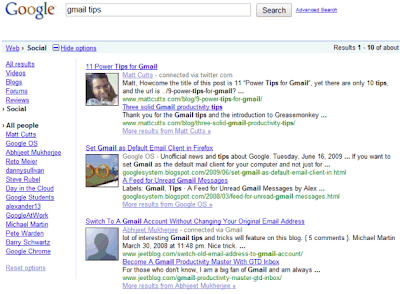
(see the first and third result)
The New York Times points out benefits, such as seeing links to pictures from your friend who recently went to Mexico when performing holiday searches for that same destination.
I'm not convinced this will hit such mainstream applications for one reason. There's a big elephant that is still not in the room: Facebook.
Let's face it, this is where most of the sharing happens. According to recent reports, we're talking about 100 million photos a day that just wouldn't make it into the Google search result pages. Going back to the New York Times example, there's a big chance that Facebook is where those Mexico pictures would have been posted, so they'll never make it to the Google search results page.
What kind of results will show up? Areas where Twitter is particularly strong: news (as the recent events in Egypt made clear), technical information (eg. the code samples and tips often searched for by developers), and location-based searches that could show up results from Foursquare, Gowalla and other similar services from local searches.
At the individual level, those who stand to gain are those who have built up a following by sharing content - the curators. (A by-product of social search could be an increase in SEOs employing Twitter curation/syndication models). It will also help breakdown the time zone barrier that has long segmented the Twitter crowd: if you post a Tweet at lunchtime in London, it will be pushed way out of my Twitter feed by the time I wake up in San Francisco. However, if you happen to be in my network, I could see your tweets show up in my search results, even weeks after the tweet.
If these social results start showing up in a larger number of searches, this is obviously a boon for Twitter (as well as the other networks Google features). It's effectively a free SEO boost.
And what could be construed as a snub to Facebook.
The fight for content from each other's network has been pretty public. Will this be enough pressure from Google to force Facebook's hand into releasing its well-guarded trove of user activity data?
That remains to be seen. One potential issue of adoption is that Google social search is heavily tied to Google Profiles and the search giant still has some way to go to make these as visible and user-friendly as other services out there (um, Facebook springs to mind).
Still, go ahead and hook up your Twitter/LinkedIn/YouTube accounts to your Google profile and try social search for yourself.


Wednesday, February 2, 2011

Google accuses Bing of 'CHEATING' (Google wants it ALL)


Google accuses Bing of 'CHEATING' (Google wants it ALL)


You could say Bing is taking a cue from its competition, but it seems to be more literally taking search results as well. Google Fellow Amit Singhal is claiming so much and has provided some amusing (if not totally clever) results from its "Bing Sting." Here's how it works: find a search term that returns no matches for either site, make a "honeypot" page manually appear for the term, then have about 20 Google employees make the search (and click the top link) using Internet Explorer with both Suggested Sites and the Bing Toolbar on. Within two weeks, Singhal claims, a handful (about 7 to 9) of the 100 or so "honeypot" results were popping up in Bing. Bizarre choices, too, like mbrzxpgjys, hiybbprqag, and indoswiftjobinproduction.

So, is this "cheating," as Singhal specifically alleges? The experiment had to be run with Bing's toolbar and / or Suggested Search feature activated, which it explicitly says are used to collect data and improve services. And more popular search terms do return different results, It's not as if Microsoft is using non-public information, but is this an example of taking an unfair shortcut? That's a debate we imagine with rage for quite some time.

Update: Microsoft's been sending out the following statement from Stefan Weitz, director of Bing:

We use multiple signals and approaches in ranking search results. The overarching goal is to do a better job determining the intent of the search so we can provide the most relevant answer to a given query. Opt-in programs like the toolbar help us with clickstream data, one of many input signals we and other search engines use to help rank sites.
That's pretty ambiguous, so ZDNet's Mary Jo Foley pressed for a followup and was flatly told "We do not copy Google's results." We're sure there's going to be a lot more analysis and discussion to come -- this ought to be fun. 

Sunday, January 23, 2011

GOOGLE TO COMPETE WITH GROUPON

GOOGLE TO COMPETE WITH GROUPON


Google is preparing to launch Google Offers, the search giant's Groupon competitor, Whilly has learned.

We have the documents to prove it -- one of our sources has sent us a confidential fact sheet straight from the Googleplex about the company's new group buying service.

"Google Offers is a new product to help potential customers and clientele find great deals in their area through a daily email," the fact sheet says.

Google Offers looks and operates much like Groupon or LivingSocial. Users receive an e-mail with a local deal-of-the-day. They then have the opportunity to buy that deal within a specific time limit (we assume 24 hours). Once enough people have made the purchase, the Google Offer is triggered and users get that all-too-familiar $10 for $20 deal for that Indian restaurant you've never tried.

From what we can tell, Google Offers will be powered by Google Checkout. It also includes Facebook, Twitter, Google Reader, Google Buzz and e-mail sharing options.

Google is actively reaching out to businesses now to get them on board with Offers. It even apparently has a writing team in place to craft the write-up for offers.

Google famously tried to buy Groupon for $6 billion just a few months ago in order to bolster its local advertising business. Groupon rejected the offer though and is instead preparing for a $15 billion IPO.

The search giant clearly isn't giving this market up without a fight, though. With its vast reach, huge resources and brand recognition, it could prove to be a powerful player in the space.

We're going to be watching these developments closely. Look here
to see the entire fact sheet Google is sending to local businesses:

Google has responded to our inquiry and sent us the following statement:
"Google is communicating with small businesses to enlist their support and participation in a test of a pre-paid offers/vouchers program. This initiative is part of an ongoing effort at Google to make new products, such as the recent Offer Ads beta, that connect businesses with customers in new ways. We do not have more details to share at this time, but will keep you posted."

Google essentially confirms Google Offers is real. It looks like Google Offers is in the testing phases, though.

We've also learned that Google will pay out 80% of a business' revenue share three days after its deal runs. Google will hold the remaining 20% for 60 days to cover refunds before sending the rest.

NEED A WEB SITE?